Have you ever wondered what legacy the first smartphones left behind? Everything started in the millennia when the large giants Mobile OS acquired a foothold in the general market. Since then, the smartphone market has witnessed tremendous growth. Many apps that have been downloaded from the appropriate app store are present on these smartphones. These apps ingest a lot of user-provided data. Innovative data management technology is needed to access and interpret vast amounts of data. Big Data can be helpful in situations like these. Want to explore more? – Continue reading!
The most vital raw resource for an online business is data. We now have more data than we know what to do with it due to the recent increase in global big data utilization. Data and processing power have increased by almost a trillion times. The evolution of approaches to handling this data is one of the critical components of this evolution. According to a study, by 2027, the big data market is anticipated to expand to $103 billion, doubling its anticipated market size in 2018.
The cornerstone of today’s widespread competition amongst mobile app development companies is the effective and planned use of data. Because it would enable them to make smarter, better fact-based decisions in real-time, enterprises want to leverage big data solutions to extract excellent insights from the data. These benefits have accelerated the use of Big Data platforms and applications. Big Data and the creation of mobile apps have provided the ecosystem with previously unheard-of growth potential.
What are Big data and its role in Mobile App Development?
People, machines, and technologies now produce a dynamic and varied volume of data. And to collect, host, and analyze such a large amount of data, new, enhanced, creative, and scalable technology is required. Big Data technology analyzes gathered data to produce comprehensive and timely business insights about users, revenue, performance, productivity management, risk, and increased corporate profits.
Speed is an essential part of the Big Data environment. Traditional analytics typically study historical data, but Big Data analytics includes real-time data. It includes information gathered from social media, machine data, audio, and video recordings, structured and unstructured data logging, ongoing preservation, and big data is of utmost importance. Big Data has made it possible for developers of mobile apps to exercise greater control over outside aspects.
Enterprises are now moving toward their goals by correlating, comprehending, and evaluating application usage.
What are the ways to use Big Data for developing Mobile Apps?
If you are new to this area and are attempting to figure out how to build an innovative app, you should be aware that not all apps released on the app store succeed. Create a strategy first to ensure that mobile app development is carried out effectively. Big Data can be helpful in this situation. It can help mobile app developers like you by giving logical insights into all the critical facets of developing mobile apps.
Let’s look at how big data is leveraged by developers and enterprises for mobile app development.
End-to-end Marketing:
Predictive Analysis is one of big data analytics’s intelligent marketing tools and services. It enables enterprises to forecast their app’s performance and suggests essential actions to boost product ubiquity. In contrast to predictive Analysis, Big Data offers data mitigation services to help mobile app developers quickly move data between other apps. This makes it simpler to run tailored marketing campaigns simultaneously across several platforms.
Big Data research also provides insights into customer purchasing patterns and demographic information to stay unique in the tech-driven world. The following are some potential impacts of using big data in your marketing:
#1 Improved price choices, content sharing options, and customer-drawing designs are provided.
#2 Resolving the clients’ problems.
#3 Offers a suggested route to approach your target market.
Knowing your audience:
Knowing your target audience is essential before building a mobile app. Big data analysis can give you proper insights into how mobile app users interact across demographics and age groups. Mobile app developers worldwide can more effectively supply their clients with cutting-edge mobile apps by utilizing big data analytics solutions. An app for booking taxis would be a great illustration of audience comprehension. Using Big Data analytics, this app analyzes current traffic conditions, taxi availability, and travel time.
Personalization:
Your app engagement will increase the more personalized an experience you provide for your users. The Analysis of your customers’ questions is made more accessible by big data. This gives you helpful knowledge about what your users like and dislike about your app and their requirements and expectations. You can offer a top-notch user experience if you have such helpful information.
Big organizations have used Big Data to make product recommendations based on the user’s purchasing history, watching history, and most recent trending products to provide tailored experiences. These kinds of tailored suggestions make each shopper’s purchasing experience more engaging.
Real-time Data Access:
The mobile app market constantly evolves as new trends, and consumer preferences emerge. One needs to be aware of these developments to remain competitive. You might be able to make intelligent selections regarding enhancing your sales conversion using big data analytics that can give you current data. The data from fitness tracking apps are a great example of real-time data.
These applications keep track of a user’s daily routines, including eating, sleeping, and other activities. The mobile app must continue to get unbroken real-time data for it to function at its best. Following an analysis of the data, the app notifies users of any anomalies.
Social Media Analytics:
Almost everyone uses social media these days. Big data can assist enterprises in tracking down product references on social media. These references may be from client testimonials, grievances, or reviews. You may develop creative ways to sell your items on various platforms by knowing how your clients interact with multiple social media platforms.
UX Analysis:
After assessing consumer needs, mobile app development must thoroughly understand app user behaviour. Big data displays the area of the mobile app where users spend the most time. You can improve the user experience and modify the design by using the data to your advantage. Moreover, developers can include more cutting-edge features customized for your target market demographic following a comprehensive analysis of user behaviour on individual aspects within the mobile application.
Wrapping Up:
Big Data is being used by businesses to study user needs and interests to create more enticing business apps. Data-driven enterprises are revolutionizing the digital world thanks to big data’s power. Businesses evaluate data to make wise judgments for effective app development and company expansion. Contrary to you, your competitors are more likely to increase sales and better customer experiences. If you aren’t using big data, you can use it to enhance overall business performance. Utilize big data analytics solutions to examine your user needs to understand them better and provide the features they require from your mobile apps.
Once you are sure about your mobile app idea, it’s time that you start investing your efforts in thinking about the right features for your mobile app. Your app’s functionalities will help you in the long run if you want to stay successful in the market.
Creating a successful mobile app is no simple task. A well-designed app will have features that reassure users that their personal information is secure and an easy-to-navigate UI that won’t aggravate users.
Building a mobile app that makes it simple for customers to accomplish their goals will keep them returning to the app and your services for more.
Here are the 10 most essential mobile app features of a successful, user-friendly mobile app.
1. Offer a USP
Don’t start a mobile app development business just because everyone else is doing it in the market. Determine the necessity, plan thoroughly, and create a mobile app that satisfies your needs. If you don’t consider these factors, your application will not benefit users in any way, and such applications are useless.
Is your software providing any utility? Offer something worthwhile for a user to resolve pain points, social media apps, or simplify the process. Ensure your mobile app is durable.
2. Keep it simple
Perhaps the most crucial component of user-friendly software is simplicity. Mobile device screens are not meant to support intricate layouts. Users may find it challenging to obtain the content they want or need due to navigating complicated mobile interfaces, which is annoying.
When creating a mobile app, it’s crucial to consider how the data will be used and ensure the page’s parts are of an appropriate size, including buttons, fonts, navigational bars, etc. Make sure you focus on offering simplicity throughout the entire design process of a mobile app interface.
3. Focus on responsive design
Any mobile app must have a responsive design, in which the content changes to fit the device’s display. Content won’t be at risk of warping with responsive design, regardless of the end user’s device. Because responsive apps immediately adjust to the device, switching between devices has no adverse effects on the user experience (UX).
Your text should also reflect this responsive design, and the copy shouldn’t be sharp and clear on mobile devices. Customers desire a seamless experience and a clear understanding of how to use the app, including which buttons to click, navigate, and other instructions. There are currently 3.8 billion smartphone users worldwide, and the app must be adjustable to various screen sizes.
4. Easily accessible search bar
Many business apps still do not have a search tool, which is not advisable. No matter how basic your mobile app is, having a search feature is crucial because everyone has varying computer skills. To keep users interested in your app, make it as simple as possible to find what they are looking for.
Any mobile app’s primary goal is to add value, but if users have trouble finding the information they require, that’s a missed opportunity. While website components like dropdown menus facilitate easy navigation, a search option extends these capabilities.
5. Provide an intuitive UX
Every program should ideally offer a simple user interface and optional, clear privacy notifications. The user-friendly UX will improve the consumer’s opinion of your brand identity, and the upfront privacy notices will demonstrate your concern for your customers’ data, thus boosting brand affinity.
6. Coding on point
Never compromise on the reliability of your mobile app. Your users want your mobile app to load quickly, open promptly, and run smoothly, and not experience any lag as they navigate the parts. This is easily avoidable – the most accessible way to find flaws and ensure the technology is secure is to conduct routine code audits.
You must ensure that your app aligns with the privacy laws controlling user data use. Although it doesn’t directly affect usability, a transparent data privacy policy will reassure users and persuade them to use the software.
7. Push notifications are essential.
Targeted push notifications allow marketers to deploy upselling and cross-selling campaigns, stop cart abandonment and notify customers when a product will be back in stock when combined with behavioral analytics. These tailored notifications efficiently reduce the customer path, encourage user retention and re-engagement, and boost conversions with timely and pertinent marketing.
8. Feedback system
Your app must include a method for users to give feedback. They should be able to report errors, request new features, and offer criticism. Thank them for their input.
9. Integrate AR
The future of mobile app “must-haves” will be augmented reality integration since it gives users a more exciting and immersive experience. AR is currently close to being widely adopted. Its features can be incorporated into many apps, from e-commerce try-on and AR-enhanced gaming to healthcare upskilling and manufacturing optimization.
10. Ensure personalization
Utilizing targeting techniques such as demographic, contextual, and behavioral, you may provide your users with individualized experiences. In demographic targeting, you can choose to target users based on their gender, race, and age. For instance, if your app distributes news articles to users, you could target your articles so that a 20-year-old boy receives articles about basketball and a 45-year-old estate agent receives articles about rental properties. The personalized experience in apps is more intense and satisfying with the introduction of technologies like IoT, AI, and ML, and it contributes to improved customer experience.
Wrapping up
User engagement must be a top concern if you want to compete in this growing economy, and mobile applications are some of the most crucial engagement tools. The time and money invested in development are a complete waste if a lousy user experience turns away your customers and has unfavorable effects.
We believe the above pointers will help you build the app your users love.
The dynamics of education have significantly transformed in the last decade. The trend of
remote learning that many imagined was not even possible, became the new normal of the
education system. The students of this tech generation would happily prefer to learn through
different apps and websites instead of sitting in the traditional classroom.
In fact, the trend of online learning apps and e-learning is riding at a rampant pace. Especially
mentioning college students who are literally fascinated by the concept of remote learning
through apps because of its extraordinary benefits. Even statistics validate the same. To
substantiate, the Allied Market Research report states that the market size of e-learning is
expected to reach $840.11 billion by 2030. That's fascinating, right?
Actually, if we keep the benefits of learning through apps in mind, that’s not so surprising to
know that the market size of e-learning would grow at such a great pace. For example, learning
through apps provides students or individuals the liberty to learn from any part of the world and
anytime in the day. This additional benefit allows students to learn at their own pace and with
their own understanding. Moreover, these apps are easily accessible, affordable, and
convenient to use, and looking at the fact that college students are just on the edge of starting
their professional life, learning through online apps is a perfect solution.
But now it all ends to which are the best apps for college students to learn and retain most of
the information about their curriculum? If you also have the same question in your mind, you
have landed at the right place. This blog will highlight the 7 best learning apps for college
students to learn and enhance their knowledge effectively. So let’s dive right into the blog
without further ado.
7 Exceptional Learning Apps For College Students
1. StudyBlue
College students often find it difficult to concentrate on their subjects when they have to
read them through boring textbooks and notes, especially at the time of final revisions.
Study Blue is a free app for college students that allows them to upload their study
material on the apps and then the app automatically converts those study materials into
interesting and engaging flashcards and practice quizzes.
Using these fun quiz games, students can effectively learn about the concepts and
revise the information in a fun way. Along with this, even if you do not have study
material, this app has more than 4 million flashcards that are already stored in the library
that can help college students in learning.
2. Wolfram Alpha
Built with almost 30+ years of research and development, Wolfram Alpha is a one-stop
solution to all the queries students have in any of the fields related to physics, chemistry,
personal finances, computational sciences, and so much more.
This app basically runs on AI (artificial intelligence) and NLU(natural learning
understanding) which makes it easier for the app to comprehend the queries just like
humans. This also allows the app to easily give answers to the student’s questions with
utmost accuracy and efficiency and will contribute to the successful accomplishment of
your SMART goals.
3. Quizlet
Quizlet is another tremendous app for learning for college students. Quizlet creates
millions of sets with billions of flashcards on different subjects that allow students to
learn and understand things in an interesting manner. Along with this, Quizlet also
provides an additional definition of every term that students might find difficult to
understand.
Further, the Quizlet also provides fun games like matching terms with their definitions so
that students can retain the information effortlessly. In fact, as per Quizlet, 90% of the
students who use Quizlet received higher grades in their exams.
4. Duolingo
There are many college students who move away from their homes to study further. In
such situations, students often find it difficult to understand the local languages. Besides,
if that’s the case with you as well, Duolingo is a perfect solution for you.
Duolingo is a language learning app for college students that can assist them in learning
distinct languages which will contribute to their self-improvement. From Spanish and
Portuguese to Klingon and German, Duolingo offers more than hundreds of courses in
more than 41 languages for individuals to learn. In fact, many more languages will be
available soon.
Duolingo covers all four sections including reading, listening, writing, and speaking to
make the user proficient in the language they wish to learn. Along with making students
learn, Duolingo also provides the certification of completion.
5. Vocabulary.com
Vocabulary is one of the crucial aspects that contribute to the personal development of
individuals that assists them in communicating their opinions and views in an efficient
manner. This is where Vocabulary.com can be a perfect partner for you.
Vocabulary.com is a digital dictionary that can assist college students in learning new
words with their meanings every day. You can even analyze your growth using various
growth boards that could be generated on a weekly or monthly basis. In this app, you
can also take different tests and compete with your friends or random users of
Vocabulary.com and see top leaders ranking globally.
6. Google Play Books
Google Play Books is another phenomenal app that could help students in accessing
thousands of books. Some of the books are free but for some, you might have to pay
some amount. The crucial benefit of Google Play books is that you don’t have to pay
hundreds of dollars to get those paper books.
Instead, you can buy digital books that can assist you in accessing the same
information. From mathematics to medical physiology, Google Play Books have got it all
covered and can assist students in saving a huge amount of money. This application is
available free on both iPhone and Android.
7. Coursera
Last but not the least application that can assist college students in learning effectively is
the Coursera platform. Coursera platform has collaborated with more than 275 leading
universities and gives free or paid access to thousands of courses offered by
universities. This platform provides certification on the completion of every course and
their course can vary up to 50 hours to 1 year of duration. These courses can add more
value to the professional and personal development of college students at low prices.
To encapsulate, there are multiple apps that can assist students in personal and
professional development. The need is to effectively understand which app is best for
you and how you can leverage the benefits of these apps. Moreover, all the above-
mentioned apps are good and can assist you significantly in enhancing your overall
efficiency.
Enterprise apps are critical in allowing firms to motivate their staff to work toward the organization’s goals in a systematic way.
Cultivating a happier and more engaged staff has a number of advantages that affect the bottom line: increased efficiency, decreased employee turnover, and more concentrated customer support are just a few of the possible outcomes of a productive and happy workforce.
Moreover, according to Forbes, High employee involvement boosts profitability by 21%, a 41 percent decrease in absenteeism, a 59 percent reduction in turnover, and employees who feel truly heard are 4.6x more likely to feel powerful.
Employee engagement can be aided by using technology to create digital channels. Of course, how you use technology has a role, but having robust digital communications that can reach all of your employees is a cornerstone of many companies’ efforts to increase employee engagement.
By ensuring that all of their employees have appropriate access to the enterprise app, business owners boost both work productivity and collaboration, and this enables businesses to communicate with their staff and collaborate in a standardized and optimal manner from anywhere on the planet.
A proficient mobile app development company designs your envisioned employee engagement app with a touch of their robust technical approaches.
You can manage employee engagement with an employee engagement app in the palm of your hand. You can adjust the story and be right where your employees are in real-time. The ultimate employee engagement apps share several characteristics, including the benefits listed below.
Common Features of Employee Engagement Apps
Surveys, Feedbacks, and Polls
How many times do you ask for your employees’ views? Do you conduct polls before a new policy or rule is implemented?
Employee apps with polls and surveys are a good way to keep employees engaged and reinforce the idea that they are being heard. Increase employee involvement by asking them which new product name they prefer, how satisfied they are with their jobs, how they felt about the company’s most recent outing, etc. Nobody stated that feedback had to be limited to work performance.
You can more easily retain your best employees and inspire all employees to perform successfully every second of the workday if you create a culture where employees feel safe sharing their minds–as long as they do so politely and respectfully.
Updates through Pop-up Messages
Any employee app should include the latest news and articles to keep everyone updated while also increasing engagement. This feature is very important as it helps to inform staff about the Morning meeting, send reminders and information about major events in the organization, and changes in company policy. This feature is very useful.
The video, photos, GIFs, and more can be used in most apps to boost engagement and involvement.
Adaptable User Interface
These days, branding is key, and a generic employee engagement application isn’t going to help your business. Branding brings together your team and makes them feel as though they are an integral part of your culture, even when you share internal documents.
Most engagement applications enable almost all features to be customized from color to logo, etc. The branding of your staff engagement application provides a team-based environment in which everyone is motivated to work to achieve their company’s objectives.
Attractive Incentives
Incentives are a fantastic method to engage employees, improve teamwork, increase morale, and promote better customer service in the workplace.
You can motivate employees engagement by providing incentives like:
Completing specific learning packages and gifting badges.
Company goods at a reduced price
Gifts include a coffee mug, restaurant meals, or a Netflix subscription, among other things.
Incentive programs can act as a regular motivator for your staff, and the app becomes just another aspect of their daily schedule.
And as if that weren’t enough, 89 percent of employees who work for organizations that promote well-being programs are considerably more inclined to recommend their workplace to friends, family, and the broader public.
Accessibility
A principle behind good participation is to ensure that all have access to and interconnectivity to information. If we work in a company, we meet many people day after day, they might be important to us, our partners, customers, distributors or people.
If someone requires a colleague’s phone number, office address, or email address, they may quickly look it up in the mobile index. You can populate your employee registration with as much or as little information as you choose. Most businesses, on the other hand, will add more instead of less.
Interactive Learning
Employee involvement also necessitates personal development and improvement. Learning opportunities are critical, particularly when learning is placed in the hands of employees.
Interactive learning has been shown to be far more successful than static learning in studies. In other words, interactive modules will help your staff absorb and retain more information than merely assigning them a book or article to read. You can save time and money by using pre-loaded video training and then allowing your employees to evaluate their understanding on their own time.
A skilled mobile app development company includes all the necessary learning features to make employees more participating and engaging.
A competitive, engaging app should have Leadership boards, which display the employees who perform the best on specific learning modules, sparking friendly debate and encouraging employees to work pretty hard and quicker.
You can use an employee mobile application to engage your employees, especially your front-line staff. A productive workforce acts as a catalyst to your business growth and engaging your employees with so many lucrative features guarantee the overall enhanced productivity of your organization.
If you find today’s article to make you consider having your own enterprise app, contact Apptread, a mobile app development company that offers various enterprise app development services with a super-specialty of fulfilling your enterprise-related needs.
Get a free consultation call when you discuss your project!
Author Bio:
Mohit Shah is a writer with a keen interest in the field of software development solutions. His enthusiasm for new technology updates makes him an avid reader and knowledge investigator.
The dramatic success of such mammoths as Uber, Airbnb, Flywheel, and Doordash has inspired entrepreneurs to open their “own”-like businesses and delve into this revenue model. That’s why startups start wondering how to create client-oriented on-demand applications and succeed.
If you’re one of those who want to make use of this trend, this post is for you. Look through it to learn how to start an on demand service app and how much money it requires.
Essence of On Demand Application
Before moving to the central (technical) part of our post, let’s outline what such a digital product stands for and what value it has for users.
In our fast-paced world, people don’t want to spend precious time looking for a nanny, doing laundry, or cooking at home (as an example). This is where on demand digital solutions come into play.
On demand service applications are designed to provide users with different types of services per request: from taxi services to flower/food delivery and online consultations with medical providers. They allow consumers to solve everyday problems (minor or major ones) in minutes by tapping a few buttons. In turn, business owners get a steady revenue flow proven by increased demand and market situations. For example, about 50% of American citizens prefer using on demand service apps due to their availability and convenience. Among other advantages are:
Most business owners make a mistake focusing only on the technical part of the product. But coding only guarantees that the platform will perform fluently. It’s the client side that helps you define the target audience, its needs, and pains. Besides, in-depth analysis will help you provide a better user experience for customers. Finally, knowing who you design apps for will help you come up with the best possible digital solution.
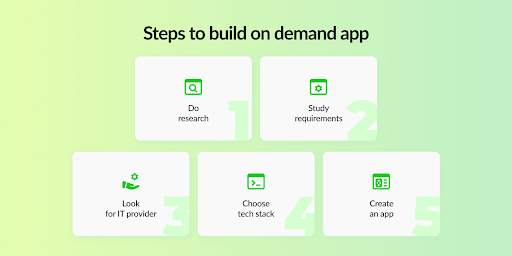
Step 2. Requirements Analysis
Before looking for a reliable IT company, you need to strictly understand what your application should do. Simply put, this stage aims to create a product vision: functionality to add and custom design. Often, clients reach the tech partner with a request like: “I want an app like UberEats.” But it’s better not just to imitate the product but to consider unique functionality to stick out from rivals. This way, the app’s user flow is amended, but there’s no need to scrutinize the general requirements. You should also think over revenue models to transform your idea into a profitable asset.
Step 3. Hiring a Trustworthy IT Vendor
You can assemble an in-house team or cooperate with an outsourcing mobile app development company. The only argument in favor of in-house engineering is employees’ physical proximity, which implies smooth communication. However, the world is shifting towards remote work, so it’s not a compelling argument now. By outsourcing project development, the app development cost reduces while the speed to launch rises. That’s because such companies have already hired all the needed specialists, and their skills are appropriately tested. Moreover, you don’t need to worry about hidden costs or other unplanned expenses since the cost estimate is discussed beforehand.
Step 4. Selecting Tech Stack
The tech stack should adhere to project requirements and the specific platform(s) you want to cover. You can go native and roll out an app for both platforms or select cross-platform app development. For example, Swift’s official framework for building Apple-based solutions, while Android OS requires Java and Kotlin. Developing an on-demand platform with Flutter is an intelligent approach to accomplishing goals simultaneously. Cross-platform solutions have a single code base for both platforms, thus cutting the app’s architecting time.
Step 5 Development
When all the hassles are done, it’s time to kick off the product engineering under the approved requirements and technology list. Take it slowly; there is no sense in implementing all the features instantly. Instead, start with MVP building to ensure your project idea is viable and proof of demand. MVP version contains only the small set of components needed to ensure the performance of main options and meet basic user needs. After gathering early feedback, you can scale up your project by adding more complex functionality and smart technology, such as AI.
This isn’t a final blueprint for such a product deployment. The number of stages may differ from case to case basis as to the demands and commercial needs.
Technical Side of On Demand App Development: Features to Add
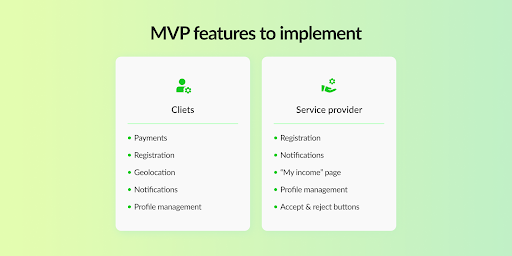
Before embarking on software creation, you should know its key elements. On demand apps’ logic implies two types of stakeholders: consumer and service supplier. It also requires an admin board to enable business owners to manage parties involved. Therefore, it’s needed to build two different solutions: user-facing and a provider solution.
MVP functionality for client app
Registration
This feature enables establishing personal touch with users, linking information to a particular client, and benefiting marketing and retargeting tools. Make the registration procedure fast and straightforward to cut the distance between the client and your app.
Profile administration
This functionality will allow users to set up and supervise their personal details: name, gender, age, address, preferred time of arrival, payments data, order history, etc.
Geolocation
This feature will allow receivers to track their deliveries or define the direction. Location-based options can be integrated using specialized 3rd party services, such as Google Maps.
Notifications
Flexible push notifications and alerts are an excellent means to earn more while improving “platform-customer” interaction. This way, users will be informed about order upgrades/reminders, expenditures, fulfilled queries, etc.
Payments
This will allow clients to pay for requested facilities featuring the platform. You can make custom payment services or integrate payment gateways, such as PayPal, Stripe, and Dwolla. In both cases, it’s critical to guarantee solid data security and fraud protection.
Features to insert into the provider’s app
Signing in and profile handling
Like consumers, facility providers should also be allowed to leave their credentials on the platform to avoid a tiring check-in process. For instance, you can add the “Login using” (e.g., Facebook) button to bridge the gap between user and new experience.
Push notifications
From the provider’s perspective, this option is necessary for sending alerts once the application for the service is submitted.
“My income” page
On-demand websites are a proven source of income. The more queries the company gets, the higher revenue is. Thus, service companies should be able to trace their earnings to ensure their proposals are proof of demand.
Accept & reject buttons
There are tons of requests service businesses should process. Therefore, companies should be capable of approving the appropriate queries or declining the improper ones within a predetermined time.
Remember: These are the indispensable group of features every on demand system MVP should include (despite the type). The core goals of creating an app MVP are to test waters, engage first movers, and compile first feedback. Thus, you can comprehend whether you need to develop your solution further or shift the focus. After you ensure mobile or web app resiliency, you can implement more complex functionality (e.g., AI chatbots, analytics, wishlists, recommendations) to enrich customer satisfaction and differentiate your product from contests.
What Does Affect On-Demand Service App Cost
How to calculate investment for such a digital startup? Unfortunately, no software development service provider can tell you the exact price until they are familiar with your requirements and what kind of app you want to deliver. The cost estimate ranges from $40,000 for simple solutions to $200,000+ for featured-rich ones. There are a variety of factors affecting the final price, such as the platform’s technical complexity, backend infrastructure, customization of visual elements, location of IT vendor, APIs integrations, etc.
I’ve decided to break down the on-demand app creation price based on feature complexity to provide insight into the average project cost.
Modest Solutions
Such systems imply the MVP version of the product. They aren’t packed with much functionality and have a plain user interface. Their core goal is to engage early consumers and gather user feedback (for further improvements). The price ranges from $40,000 to $130,000.
Average-complexity solutions
These types of software require more money, time, and constant enhancements. The developer’s approach individually to interface design and integrating more intricate functions. The project estimate begins from $130,000 and goes up to $250,000.
Complex solutions
Such solutions relate to enterprise-level ones (e.g., on-demand apps for logistics) and are made to digitize commercial operations and generate incomes. They’re custom-built and contain high-grade improved functions (e.g., real-time monitoring). The price starts from $250,000+.
Summing Up
Such a massive market as online on-demand services asks to be digitized and more accessible for everyone. And web/mobile platforms are time-tested tools to enhance customer experience yet get a steady income. On demand delivery service apps bring colossal value to users. They simplify the order monitoring process, save time, and streamline everything from leaving a request to receiving the desired service. Everything is just a click away, whether you need to arrive at a set destination or receive food delivery to the door. As for the business owners, they get an opportunity to make money successfully due to increased demand for such digital solutions.
Author’s bio
Yuliya Melnik is a technical writer at Cleveroad, a web and mobile app development company. She is passionate about innovative technologies that make the world a better place and loves creating content that evokes vivid emotions.
To begin with, Java is a machine language that permits you to compose program instructions or directions utilizing straightforward english syntax and statements instead of entering confounded numeric codes. Moreover, in light of the fact that engineers can undoubtedly peruse and compose with top to bottom information and experience, this makes it the most reasonable programming language for a great many designers.
Be that as it may, it isn’t the case simple to peruse. The Java programming language has boundaries and guidlines that designers should follow while composing code. These guidelines are generally known as the linguistic structure of this programming language. When the English guidelines notes, they are additionally changed over into equivalent mathematical codes effectively comprehended and executed by the PC.
Java is an open-source, object-based language that is one of the most famous decisions among different dialects. Java is perceived to act as an illustration of the best programming dialects and makes the way for development in coding. The Java programming language is turning out to be increasingly more open consistently.
Aside from the reasons referenced above, there are other convincing motivations to recruit Java application designers to foster or create an application that impeccably accommodates your business needs and financial plan.
Object based language for programming:
This feature makes Java the most well known programming language among designers. Java is an object oriented language, and that implies that it follows a programming style that incorporates ideas like class, object, legacy, and so forth.Creating an application using this language and technology is a lot simpler in light of the fact that it helps keep the framework secluded, adaptable and extensible.
Despite the fact that Java permits utilizing an object based designing model, it makes working with code in this language ideal for programmers and developers.
Open source language for programming:
As examined above, engineers can utilize the source code while developing or creating a Java application and change the coding of the application as per their prerequisites. Don’t bother composing code without any preparation! Simply recruit a developer who can rearrange the codes or utilize similar standards for improvement.
Java likewise has a bunch of phenomenal programming constructs that make designers’ approach more straightforward and permit them to make an application that impeccably meets your requirements.
Furthermore, this programming language offers many open-source libraries that at last diminish the general expense of creating an application and accelerate the process.
Consistent support from the developer community:
Likewise with Android, designers can likewise profit from consistent expanded developer community support that permits issues to be settled when they emerge. Furthermore, that is not all, the programmer community invites all engineers, whether experienced or amateur, and gives truly necessary continuous help.
Java designers can acquire certifiable information on the programming language from similar engineers and grow their worth all over. A functioning developer community shares information and related data to assist amateurs with further developing their coding abilities.
Whether you really want support or backing to take care of an issue or to keep the discussion on a similar level, the programmer community is consistently prepared to pay attention to you.
Easy to learn platform for programmers:
The main motivation to recruit application engineers to create versatile mobile applications with Java is that its expectation to absorb information is steep. Be that as it may, in most expert ventures, becoming useful in a brief time frame with this programming language is difficult.
Likewise with plain English, Java has a familiar English linguistic structure with as scarcely any extraordinary characters as could really be expected. For instance, standard coding sections make creating code more straightforward to peruse and comprehend.
Versatility offered makes it a great choice:
Java’s outrageous flexibility makes it a good choice to use across multiple platform. What’s more, this programming language works across all platforms, which is the reason an the programming and development community has picked Java to foster the ideal mobile versatile application.
You probably heard the well known Java motto “create once and run anyplace,” which eventually implies that you can execute Java coding on any equipment. Thus, for instance, assuming that you have made an application for Windows, Java’s flexibility permits you to run it on some other platfrom.
Powerful and capable development tools:
In all honesty, Java accompanies the absolute most remarkable versatile application advancement apparatuses, like Eclipse, Netbeans, and so on. Tools like Eclipse and Netbeans are critical in making Java one of the most mind-blowing programming technologies for portable mobile application creation.
A powerful tool kit helps you in coding and furnishes you with the capacity to add to troubleshooting, which is fundamental in genuine turn of events. A coordinated advancement climate (IDE) makes Java improvement more open, quicker, and smoother. Utilizing an IDE makes it simple to look, read code and alter Java code.
Java is available for free;
Don’t you like FREE stuff? So why not pick Java application creation professionals for your versatile mobile application?
You can recruit application engineers to become familiar with this programming language and create your application at the most reasonable cost. Additionally, since Java is free, you don’t need to pay anything for Java application advancement.
Since Java has no sticker price, it likewise assisted Java with becoming well known among individual software engineers and huge associations. At last, assuming you are as of now considering how to get everything rolling with Java programming language, look at the most rumored Java application development organizations.
Assuming you’re actually asking why you ought to pick Java for portable application development, look at the measurements that show how well known Java is among engineers. You can Hire Java Developer if you are looking for a Mobile App Development Company for your Business.
Some popular stats for Java
As per Tiobe, Java was the most well known language for application improvement in 2017 in light of measurements and patterns.
It is assessed that the Java programming language involves the vast majority of the market and gives 26,269 positions to Java engineers.
As per GitHub’s yearly audit, Javascript, Python, and Java produced the most draw demands.
Is Java a perfect choice for Mobile app development?
Java is as of now the most famous programming language for everything from versatile application advancement to investigating various work processes by customary estimations. Notwithstanding, while discussing Java in portable application development, Android has figured out how to keep Java at the very front lately.
Java is the most ideal decision for Android portable application creation and offers the capacity to foster native applications utilizing local tools. A java application development organization permits you to code in different dialects too. In any case, it might be ideal on the off chance that you had a novel system to change over local applications to this API.
We live in an age where there is an app for everything. Need to shop in the comfort of your home? There are plenty of eCommerce apps. Want to track your monthly expenses? Financial apps can help you do so. Undoubtedly, mobile apps have evolved into “go-to” solutions for virtually everything.
Since technology advances daily, there is a broader scope for developing innovative apps that solve problems and become a part of our daily lives. The increased app usage calls for creative application ideas and timely execution. Other than that, financial resources, effort, and project management are equally important.
While there is an app for everything, we have rounded up some innovative and new app development ideas to explore in 2022. If you’re new to the industry, this is your guide to 7 trending niches that you can invest in and launch an app. Keep reading for more.
1. Healthcare Apps
Healthcare applications link the demand-supply gap in medical services. The best part, you don’t have to be a doctor to build a healthcare application. Nurses, psychologists, health care professionals, etc. fill gaps in the health-tech sector to expand their service delivery to remote locations.
Here are some popular healthcare application ideas that you can investigate and develop right away:
Mobile games are undoubtedly a financially rewarding app niche. Yet, it requires a significant initial investment as well as large development budgets. This is because game development necessitates stunning graphics and a seamless user experience. It requires excellent navigation, performance, and loading speed. Here are some current game development trends:
Augmented Reality (AR) games
Virtual Reality (VR) games
NFT games
Games of investment with redeemed options
Games to earn cryptocurrency, and much more
Before you start working on a mobile games app project, make sure to set your budget. For example, optimize your budget effectively. What you may do is outsource your project instead of employing an in-house team.
3. Smart Apps
Smart apps control home and office features via the Internet of Things (IoT) and embedded systems. These functions, above all, regulate lighting, temperature, pet and child care, alarm and lock systems, plants, and kitchen systems.
Apart from that, some smart apps now control car parking as well as home electrical appliances. Similarly, these intelligent apps collaborate with central hubs to automate internal processes.
4. Smartwatch Apps
Next on our list is a unique app development domain: smartwatch apps, especially for Wear OS and Apple watches. Mind that it is not for mobile phones. Smartwatch apps allow users to conveniently manage some of the day’s most important functions on their wrists. These apps let users monitor information and control it in several ways.
Here are some ideas for smartwatch app development:
Weather-related applications
Apps for alarms, reminders, and taking notes
Monitors for heart rate
Sleep trackers
Calculators for physical activity
Instant messengers
Moreover, when developing a smartwatch app, designers need to balance minimalism with creativity when working on the user interfaces as well as user experiences.
5. SaaS Apps
These apps are developed by SaaS software developers and hosted on centralized servers. Such apps’ target audiences include high-profile individuals, corporations, and business users. Here are some popular SaaS development concepts:
Productivity software, task management software, and communication software
Tools for operations, word processing, and file storage
Tools for lead generation, content automation, and design
Customer relationship management and enterprise resource planning software
The majority of these SaaS apps are monetized via monthly or yearly subscription plans. Because the backend does not run on the device, these require a different development approach. However, this diversity has made development easier. Automatic updates have increased investor confidence, and they are eager to build MVPs and scale later.
6. eCommerce Apps
Mobile apps have greatly influenced how we do different things. Above all, it has reshaped the way we shop. Today, both retail and wholesale shopping models use eCommerce integrations. For example, online shopping giants like Amazon, Alibaba, Etsy, and others have mobile apps that have played a huge role in their popularity and success.
If you are interested to build an eCommerce app, here are three different options for you.
The first option is to build an eCommerce app in which you are the sole seller on the platform and your target users are people who want to buy your products.
The second option is to develop an eCommerce marketplace application. This platform is intended for a large number of buyers and sellers.
The third option is to develop a community-related app for a particular audience. Golfers, doctors, teachers, cricketers, runners, and engineers are just a few examples.
When developing an eCommerce application, keep the UX design trends in mind as well. Besides, here are a few eCommerce app ideas.
A platform for selling clothes, shoes, etc.
An eCommerce app for selling office supplies
A shopping app for pet care accessories
7. Financial Apps
Financial apps aid in the automation of services such as banking, loan acquisition, credit management, and money transfers. Take the example of MoneyLion, a digital banking app that helps in making ends meet.
Besides, other financial applications also use artificial intelligence and machine learning, also known as fintech apps that send investment ideas, advance paychecks, manage health, and much more. Below are some examples.
There are plenty of ideas to try. If you’re a beginner, start with the basics and level up as you gain experience. The demand for high-quality apps is increasing, so make sure to benefit your business from its use.
What is the role of Artificial Intelligence (AI) in the mobile app development industry?
This question is drilling into the minds of businesses across verticals who have plans to invest in mobile app development. Artificial Intelligence and Machine Learning (ML) technologies are renovating the business models and encouraging brands to stay under the fingertips of the targeted audience through intelligent apps.
Starting from providing virtual customer support services and face detection to voice-enabled search facilities, the power of AI-powered mobile apps is ensuring outstanding user experiences and optimizing the quality and digital standards of brands.
This trend is driving the demand and use of Artificial Intelligence and its sub-technologies in the mobile app development industry. E-commerce players, retailers, bankers, Fintech companies, manufacturing units, transportation sector, healthcare, and fashion industries are all highly investing in custom AI app development to accelerate digital wave and provide top-notch automation and bring a great impact on service deliveries.
Today, we would like to discuss which AI technologies are playing a key role in the development of brilliant user-engaging Android and iOS apps.
Significant AI Technologies Used For Building Interactive Mobile Apps
Machine Learning Technology For Prediction and Behavior Analysis
Machine learning is one of the key technologies of AI. Integration of ML capabilities in mobile apps, in particular, e-commerce apps, e-learning apps, or online delivery apps, is really a value added move by developers.
The global organizations are switching to use ML in mobile app development for various purposes, such as analyzing audience needs and preferences, categorizing customers, and forecasting product demand etc.
Speech-To-Text Recognition Technology For High Accessibility
It is one of the most popular AI trends in the mobile app development industry. Mobile app developers are infusing speech recognition into apps to facilitate quick and convenient access to users.
Integration of voice recognition technology in mobile apps will allow end-users to toggle the microphone or voice assistant and start accessing the app with their voice. The built-in powerful speech recognition algorithms converts user voice to text and provides the desired content as per the user’s search query.
Pattern Recognition for Biometric Authentication
Pattern recognition is a significant trend in the AI app development industry. Mostly, Mobile apps development companies in Saudi Arabia are adding biometric authentication features to banking apps, insurance apps, investment apps, Fintech apps, and e-wallet/online payment apps to ensure the high security of the confidential data.
Pattern recognition algorithms and tools authenticate the biometrics, such as fingerprints, iris, voice, etc., validating and verifying the user’s identity. It will improve the application security and build trust among the app users.
Natural Language Processing (NLP) Technology For Quick Response
Siri is the most successful symbol for AI-based voice-enabled applications. Siri-like NLP-based software application is beneficial for both personal and professional purposes. It can be used as a virtual personal assistant that schedules meetings, reads/sends text or emails, and we’ll organize daily routines by just interpreting the voice commands. Hence, iPhone app developers are adding NLP capabilities into apps to enable more convenient and comfortable app experiences for users.
Emotion Recognition Technology For Tracking Audience Sentiments
It helps brands identify and analyze the emotions of online and offline customers. AI mobile apps derive insights into emotions by determining the user’s feedback.
On the other side, retailers too can benefit from AI technology in many ways. By deploying AI-based in-store virtual assistance, retailers can monitor customers’ behavior and track their facial expressions seamlessly. This strategy is helpful for companies in improving the service/product quality and reaching the satisfaction level of their in-store or online customers.
Face Detection Technology For High Security
Face recognition technology plays the best role in identifying facial features and authorizing app permissions. This technology improves the app security and prevents unauthorized access to the application. Hence, facial recognition is a great addition to mobile apps that let users unlock their apps seamlessly.
AI Chatbots For Smart Virtual Assistance
The AI Chatbot trend is spreading across the world of businesses with jet speed. AI-powered Chatbots are the symbols of continuously emerging digital technologies. They will act like human customer support agents.
Mobile apps with Chatbot facilities respond to user queries immediately and increase their app experiences. AI Chatbots assist companies in delivering 24*7 support services.
Image Recognition Technology
Mobile app development using image recognition is an attractive trend in this AI world. Mobile application development companies are integrating image recognition features in e-commerce and QR code scanning facilities. It will make invoicing, billing, and payment-like processes faster and easier.
The AI-based eCommerce apps development with an image recognition feature will allow users to upload or scan product images to make their search easier. It will ensure optimized search experiences for users.
Accordingly, one of the best advantages of image recognition in AI application development is identifying disease types. Yes. AI-based image recognition apps are widely deployed in the health sector for analyzing disease symptoms and identifying disease names.
These are a few significant applications of AI in the mobile app development industry. AI can also be increasingly used for developing language translation apps, IoT-powered fitness tracking apps, etc. However, one cannot imagine how AI will impact the mobile app development industry in the coming years.
Wrapping Up
As we discussed yet, the use cases of Artificial Intelligence in mobile application development are incredible. AI, together with its technologies, is accelerating mobile app technology. It will help app developers build bespoke Android and iOS apps that ensure the best user experiences. AI-powered mobile apps will transform the communication medium between brands and end-users.
Not only for developing Business-to-customers apps, but AI is also playing a major role in the enterprise-centric mobile apps development for streaming and automating the operational and sales processes. It’s the right time to integrate AI into mobile apps and stay on top of the AI world. So, the investments in AI are appreciable.
Let’s invest in AI technology and build unique, intelligent, engaging, collaborative, and futuristic mobile applications to remain competitive in this digital sphere.
Author: I’m Anita Basa, a fascinating Technical Content writer currently working at “Hyena Information Technologies”, one of the best mobile app development company in Delhi, UAE, USA and India. Interested to know about technology updates. Mobile App Development, IoT, Artificial Intelligence, Machine Learning, IOS, and Technology-related content Get connected with me on Linkedin
Due to the enormous worldwide usage of personal smartphones, almost every consumer business now has or should have a mobile app. And, if a company decides to go mobile-first, it must be unambiguous and insightful about it.
What does it cost to create an Android app for your company? It’s the first thing you should consider when estimating app development costs in 2022.
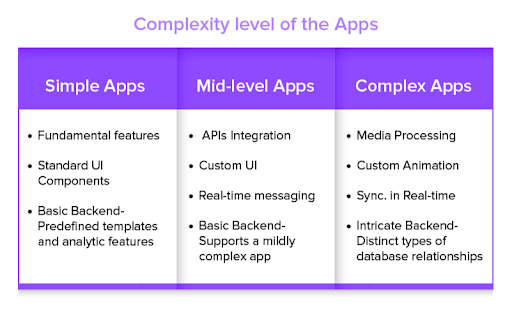
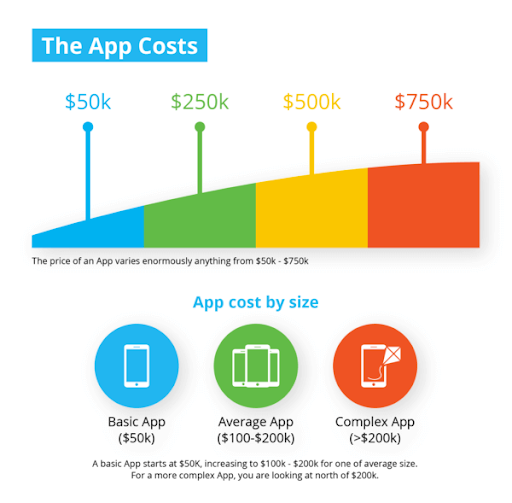
Here we have a high-level view of Android App development costs depending on the scope and complexity of the App:
Cost of a Simple App – $40K to $60K
Cost of Moderate App – $60K to $150K
Cost of Complex App – Begins from the range of $300K
Though this is a generic price range, the cost may vary depending on the,
1. Location
2. Scope
3. Complexity
4. Functionality
5. Design
6. Security
7. Infrastructure, and
8. Category of the Application and Many More…
To understand these cost terms of Android App development, we have drafted a concise elaboration of everything you need to know to do a thorough cost analysis of your Android App development. Ultimately you will be able to choose a compatible mobile app development company that meets all your needs.
Why Do Industries And Businesses Prefer Android Applications?
Like Nikon and Canon, or Pepsi and Coca-cola, Android and iOS have long been rivals. Both have a large fan base and work hard every day to prove better than the other. Because of the rise of both of these platforms, the mobile app development industry is growing.
According to emizentech statistics:
● In 2020, the Google Play Store had around 2.95 million apps accessible for download.
● According to Statista, 96.9% of Android applications are freely available on the Google Play Store in August 2021.
● Android has almost 2.8 billion users.
● About 49% of mobile apps check the Google Play Store 11 times daily.
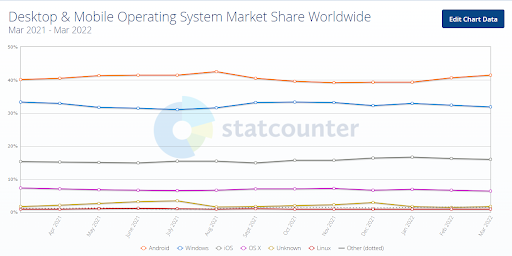
Android OS is the clear winner, with over 45 percent of the worldwide Operating System market. However, this isn’t the only reason business owners prefer Android to iOS.
Below mentioned are the top 5 factors that make Android Apps drive over iOS Apps:
1. Easily Customized
Because of the Play Store standards, Android applications are very configurable. Developers can add universal apps to current systems to improve functionality or streamline processes. Your app should accurately reflect your company’s vision, which can accomplish mobile application development. Android also has a lot of scalabilities, which is essential for any company or a well-established company.
2. Easy Integration
The Android platform allows for internal app integration and effective customization to match the organization’s needs by providing the necessary tools. In addition, these apps are simple to integrate using third-party APIs, which cuts development time in half.
3. Broad Customer Base
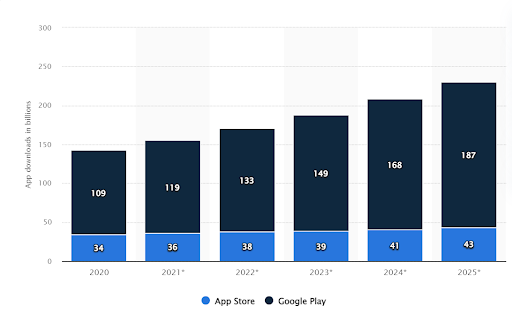
You’re probably aware of the Android platform’s widespread popularity among users. Android app downloads for 2020 totaled 109 billion, which justifies its fame. According to Statista, by 2025, customers will have downloaded 187 billion apps from Google Play Store. Therefore, you will be able to reach millions of people with your app, generating an even greater ROI.
Another advantage of designing Android apps seems to be that they work with a wide range of devices on the market. Because Android dominates the market, many manufacturers (One Plus, Samsung, and others) create Android-based devices. One of the main reasons for this is the lower cost of Android-powered devices than Apple’s.
5. Enhanced Security
Your android application must be well-protected and free of security flaws. Android application development generally depends on Linux, ensuring the security and better control of any android app on Google MarketPlace. It also comes with built-in protection from viruses and malware.
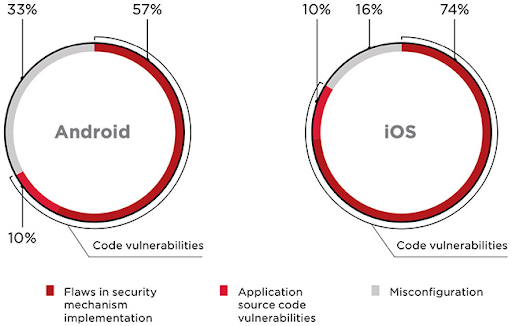
The below figure depicts that iOS Apps are found to have more code vulnerabilities compared to Android Apps.
If the Android platform has piqued your interest, you may want to learn more before using it for any application development needs. As a result, the inevitable question of “How much would it cost to design an app?” will arise in your mind.
Though it’s difficult to give a precise figure, a few key factors play a role in deciding the cost of developing a mobile app. But first, let’s have a look at the mobile app cost calculator formula.
The Formula For Estimating Android Application Cost
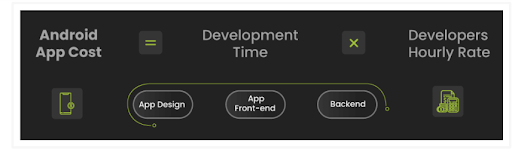
A formula has been developed to quantify the cost of Android app development accurately. All you need is to calculate the cost of your App design individually, Frontend features and backend features, and multiply it with the cost spent on the hourly rate of the developers.
To instantaneously estimate the cost of the development time, use venturepact.
Critical Factors Affecting The Cost Of An Android Application
The complexity of the app and the number of features it contains are essential variables in determining the ultimate cost of Android app development. They aren’t, however, the only ones. So let’s glance at some of the aspects that affect the cost of developing an Android app.
1. Number of Features
Since you control which gadgets and applications you want to support, a bring-your-own-device (BYOD) app for internal users is undoubtedly more inexpensive than a bring-your-own-app (BYOA) app for external users.
Depending on what features and functionality you choose to include, the price of your app will vary. As your app’s features and options expand, the price will rise.
Therefore, you must distinguish between your application’s primary and secondary functions.
2. Numbers of Screens
The number of Android app screens will affect the development cost. The number of screens depends on the functionality of the app and the coherence between them. The UI and UX elements make a difference. For example, advanced animations will cost you a little more than usual if you are using advanced animations.
If the functionality of your app is interdependent on many pages, then the complexity of the app development increases, thereby increasing the duration of the product. Which is directly proportional to the overall development cost
3. Complexity of Features
Developing a mobile app depends on the type of app you want to create. Therefore, your design team will evaluate the person-hours you need to incorporate your requirements several times before starting cooperation. This is a crucial step in the project preparation process.
The app’s features and functions, platforms you want to build for, visual design customization, the sophistication of backend infrastructure, and administrative and maintenance costs (which we’ll discuss later) are essential aspects that influence our development prices.
The number and complexity of functionalities you plan to include in your app will, in reality, determine the cost of app development. Of course, we’re referring to how much business logic needs to be translated into software and how many screens, widgets, and other features require third-party integrations, such as in-app purchases.
Certain features are relatively easy to implement, while others are more difficult. As a result, the development team may employ ready-made solutions or develop code from scratch, depending on the intricacy of the project.
4. Size of the Development Team
The choice of your app development company has a significant impact on the overall cost. You have two options: hire a professional Android application development company or hire a freelance Android developer.
The cost of the generated app will be minimal if you hire a startup development business or even a team of freelance Android app developers. They will focus on improving their portfolio, with monetary gains coming in second.
A company has access to the most up-to-date technology and specialists who work tirelessly to make the apps the best. In contrast, a California app development company with a larger workforce will focus on clients that can pay more since it has a bunch of mouths to feed. However, the finished product will be well worth the investment but will be superior to that of freelancing developers.
However, a few exceptional Android development businesses provide excellent mobility services at a low app development cost, making them ideal for startups.
5. Online vs. Offline
It is your mistake if you believe that offline apps have no value and that all apps must be online to be relevant, competitive, and valuable to your company’s needs. An online Android app takes more time and effort, which results in higher Android app development costs.
On the other hand, an offline Android application is less expensive and less time-consuming. To choose between online and offline development, you must consider your Android app development requirements.
Android app development costs are directly affected by the size of your application. Therefore, a larger Android app development project will require more resources to create and maintain.
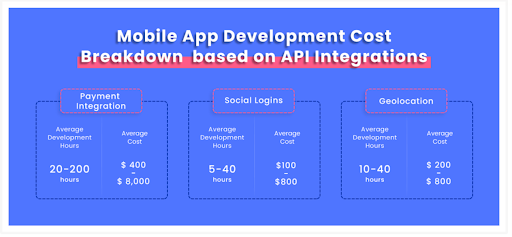
7. API Integrations
API integration is a messaging system that allows businesses to automate numerous business activities by establishing seamless connectivity. It connects two or more apps via their APIS, allowing them to exchange information. When developing an Android app, there are numerous ways and scenarios in which you may need to establish multiple API Integrations to add various functionality to your app.
If you want to build an eCommerce Android app or add any products or services that your users can buy, you’ll need to incorporate a payment system that allows them to pay through net banking, wallets, or other means.
Payment APIs allow Android developers to integrate most of these payment gateways straight into their apps.
The average time it takes to integrate payment gateways into a Mobile application is 50 hours or more. Given that you’ll be using at least two payment services in your Android app, the typical cost of this functionality will be between $2400 and $5k.
8. UI/ UX
Modern users value beautiful design above all else. Therefore, it is nearly impossible to create a remarkable product without a skilled designer who can provide UI/UX design services.
A designer’s responsibilities include:
● Reviewing relevant applications
● A study of the preferences menu
● Wireframes development
● Designing the final product
Hence, you should also consider the complexity and the features of UI/UX design in your app development cost.
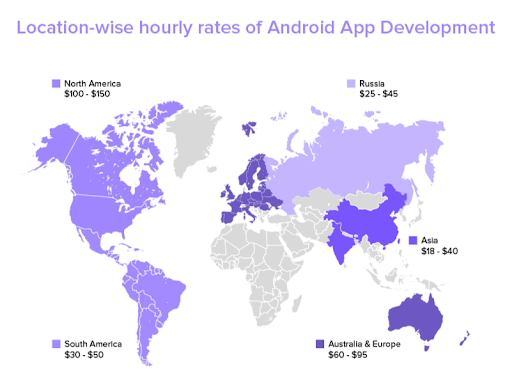
9. Location
The location element is equally important in evaluating the entire cost of app development. Due to specific factors governing each region, the price and quality of the same services can vary significantly worldwide. For example, the pricing of a mobile app development company in California can differ considerably from that of an app development company in other regions such as Texas, Florida, etc.
Source
As illustrated in the map below, the difference between the west and the east is unavoidable. In this regard, you need to keep in mind that the cost of Android development in India is far lower than in the United States or any other Western country. This is due to several factors, including the abundance of technologically skilled people and lower prices for their services.
10. Hidden Costs
Apart from the app development costs we’ve already addressed, you should be aware of several hidden fees associated with Android app development.
Here’s a list of some of these hidden costs:
● Hosting
Your Android app needs a trustworthy and dependable hosting provider to store user data and ensure the app’s proper performance. The price of your hosting plans will depend on the type of material your app typically consumes. For example, video formats require more processing power than static media such as text. Aside from that, you’ll need to pick a hosting package based on the number of active users, predicted growth, and other factors.
● Maintenance and Monitoring
When determining your Android app development budget, keep in mind that maintenance is a recurring expense. It’s critical that your app runs smoothly and is free of bugs or malfunctions that detract from your customers’ experience. The cost of maintenance will depend on the app’s scalability and size.
● Upgrades
You need to update your app regularly to remain competitive in the marketplace and for your users to see that you are continually improving their experience. Updates also aid in delivering new features, the improvement of issues and repairs, and improving the program’s overall appeal.
● Licensing
Launching your Android app on the Play Store requires investing in an Android app license.
● Notifications
It is dependent on the service provider. For example, you may use platforms like Twilio to incorporate SMS messaging services into your app. Also, push notifications to boost user involvement and inspire your users to do the activities you want them to take.
● Email Integrations
Email integration allows you to send promotional emails, special discounts, and other marketing materials to your users’ email addresses.
How to Cut Down Android App Development Costs?
Here are some suggestions for minimizing your Android app development costs:
1. Prioritize Features
Sit down with your team during the planning stage of developing an Android app and talk about the features you’ll require. Then, reduce the number of options to the most necessary and sensible for your app. Finally, run your test app inside the field and collect feedback to learn how to improve and progress with your Android app development.
2. Build an MVP
Build a minimum viable product (MVP) with basic functionality that general users and app developers may test in the early phases of app development to save money on app development. Then, during that time, if there are any issues, we can resolve them instantly.
3. Make a Documentation of Your Requirements
Planning is essential for getting your Android app development project off the ground. For this, you need to write a product requirement document that details your app’s features and the technology stack you want to employ to develop your Android app.
In addition, your paper should include details such as the company’s history, app features, a timetable, the reasoning behind the app’s development, budget estimations, and platform requirements. This tactic will save you the costs of requirements planning.
4. Choosing an Offshore Android App Development
A business with Android app development experience can only assist you if it fits your price and requirements. So, to obtain the most return on your investment, hire the best Android app development company.
Choose Wisely, and Get Your Best Android App at an Affordable Price!
So that was everything about app development and how much it costs to create an app. Now, it is your turn to use this app development cost guide to create a fantastic Android app for your business and estimate the cost of mobile app development.
Author Bio:-
A Content Marketing Specialist with over 7 years of experience. I have experience in creating brand awareness for various app development companies. Currently I am working with Parangat Technologies & helping them spread awareness about digital transformation.
You might use loads of mobile applications created by your favorite brands or businesses. It’s common for companies these days to enhance engagement with consumers and increase brand awareness by making an app for their business.
Consumers today use their smartphones to find the products/services they need. Therefore, businesses that don’t have a functional application might be losing customers and leads.
All industries are constantly evolving and the internet marketing industry is no different. The trending technologies of today can become obsolete tomorrow.
Businesses need a fully functional and engaging mobile app. This allows buyers to come back to a certain brand/business thereby, increasing its bottom line.
Expert developers often earn money in four figures from only one client. Smartphone applications are essentially changing how brands engage with consumers.
Most people use apps to book movie tickets, buy online, get groceries and food delivered, and secure doctors’ appointments. It all needs just some clicks here and there on their mobile phones.
This blog is for you if you want to build an app for your business or for any other purpose. Here is a step-by-step beginner’s guide to creating an application.
Come Up with an App Idea
Firstly, you don’t have to come up with an entirely novel idea. New apps are mostly variations of existing applications that have problems, so new apps are developed to solve these issues.
Think about a problem that you face and want an app solution for that issue. You can be the developer of that app. No matter what your concept is, make sure that your app product can make users’ lives easier.
You can also merge ideas from two or more popular apps and make a single app by mixing them. Or improve an existing app by tweaking its functionalities. For example, you can improve an existing dating app by making it say, more secure or easier to use.
Carry Out Market Research for Competition
Most likely, your app will have competition already waiting in the app stores. Don’t feel bad if you see tons of applications dealing with similar issues your app is dealing with. This shows that your idea is possible and many users need it.
Some apps may be claiming that they can handle an issue but that doesn’t mean they are actually doing it as users want. Your competitor apps may become old or their owner may not have updated them for a long time.
Your market research should include going through reviews and ratings of competitor apps. Focus on the app name, price/monetization plan, features, app author, date of the last update, and the number of downloads.
Determine the Feature Set of your App
Only add those features in your app needed to fulfill your product’s main functionality. We know that you may like to pile up loads of unnecessary features on your app. But remember they can weaken your app’s ability to perform its primary purpose.
On top of that, extra features will make the android app development or iOS development Dubai costly and more time-consuming.
You can add helpful features from this list of popular features:
Community wall
Push notifications
GPS capabilities
Video, picture, and audio hubs
Surveys and questionnaires
Booking abilities
Menu ordering system
Calendar integrations
Consumer loyalty
Ecommerce carts
User directory
The key is simplicity when it comes to the initial stages of app development. If your application’s core purpose doesn’t need calendar integration, there is no need to thrust this unnecessary feature into the app.
Make a Wireframe
A wireframe is a rough outline of your app. It can be made on paper, a handkerchief, a blackboard, or digital wireframing software. It doesn’t need graphic design or other formalities. You just have to determine the app’s features and outline the schemes.
Plan your App’s Marketing Strategy
App stores like Google Play Store and iOS Appstore house millions of applications. Why would a user download your app product? The answer — you should present your application to the right consumers.
Nowadays, many app builders start marketing even before the app is released. Creating a pre-release email list is something nearly all app authors do along with using paid ads to market their app.
Specify the Technicalities of your App
Here you will make use of the wireframes you created before starting app development. These wireframes will help you with technical specifications.
These belong to the back end of your application that you need to work on. Your technical specifications can possibly identify alternative methods to attain your goals. By determining these specifications beforehand, you will save a lot of time and thousands of dollars.
Don’t think that you won’t be able to find alternative solutions. Gather the information and then weigh different methods.
Pick a Development Method
There are many app development methods including hybrid app development, native app development, rapid app development, and development using a cookie-cutter app maker.
Only you can tell what method is best for your unique conditions. The factors you should consider are your level of technical knowledge, budget, app category, and time to market.
Make your App Go Live
It’s time to deploy your application. Focus on visibility and uptime at this stage. Your mobile application should be completely functional. Users won’t like it if your app crashes or some other issue happens.
App developers have to submit their apps to different app stores. Google Play Store and Apple Appstore have distinct submission guidelines that developers should follow.
Conclusion
Mobile app development is a lucrative business because apps increase their revenues like crazy. These applications enable companies to stay connected with their audiences which results in more customer retention and engagement.
Usually, building an app requires technical skills and marketing proficiency. This makes app development mind-boggling and a long process for newbies. According to your unique situation, you can decide whether you want to take help from professional app development services, or create the app on your own.